

NOTICINGS: Peace of Mind
In Spite of Everything
This is a long NOTICINGS. It moves slowly, because what is being lost does not disappear all at once.
A daily walker with his dog approached another daily walker in the park. One man does not have a dog, but he carries treats and offers a good rub to the dogs who pass. The dogs—and their people—have known him for years. I walk there daily too. Hellos. A handwave as we go along.
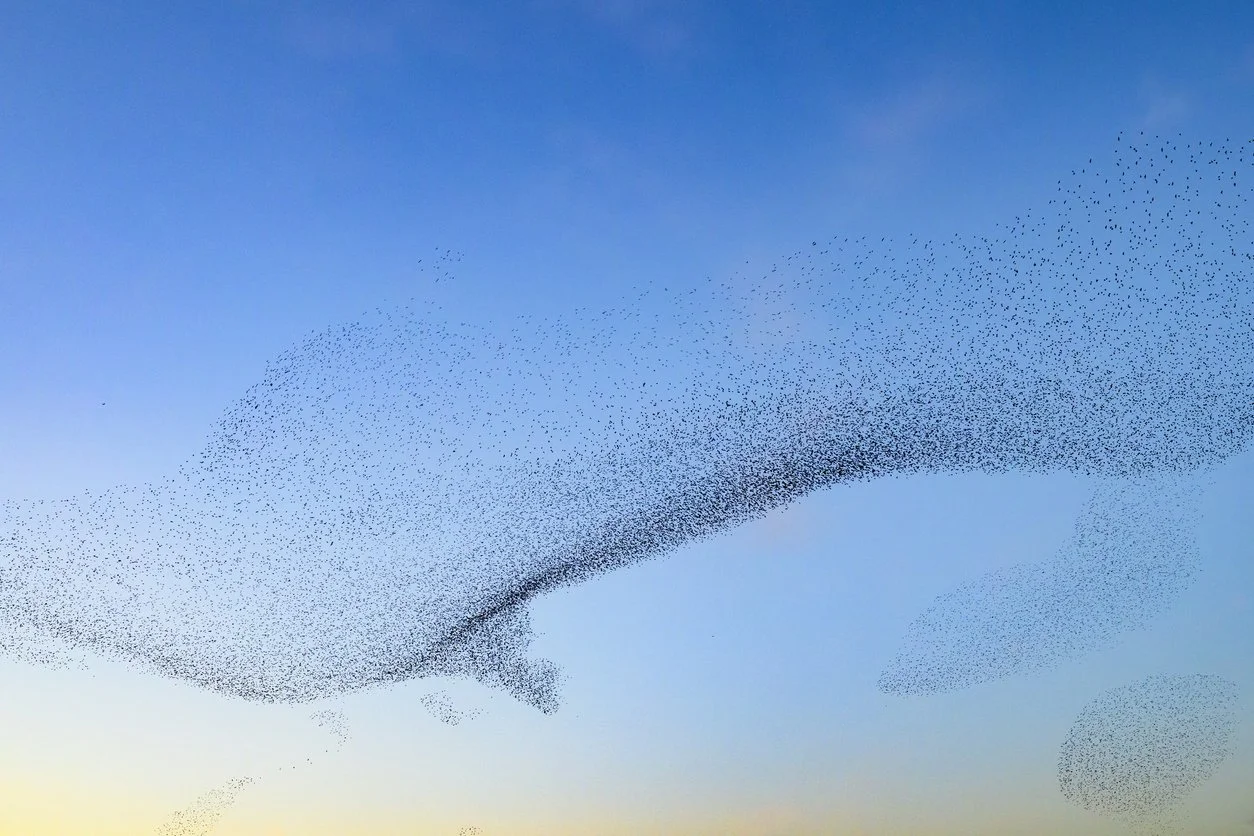
Photo source: Sjo, www.sjo.nlSomething happened—a man pulled out his gun. In that instant, peace of mind vanished. The armed man later pleaded not guilty.
The threat was not private. Two park regulars were seated and talking when the gun was drawn. One witnessed the moment and later testified in court. A photograph captured the man holding the gun, aimed.
What remained was not only evidence, but aftermath.
The man at whom the gun was pointed cannot sleep. His fear is not abstract. He has already survived one heart attack. The presence of unresolved anger—now constrained by a restraining order but not dissolved—casts a long shadow. This is not a nervous system at rest.
The image exists. The testimony exists. The law recognized the weapon’s legality; it does not recognize the damage it portends or follows.
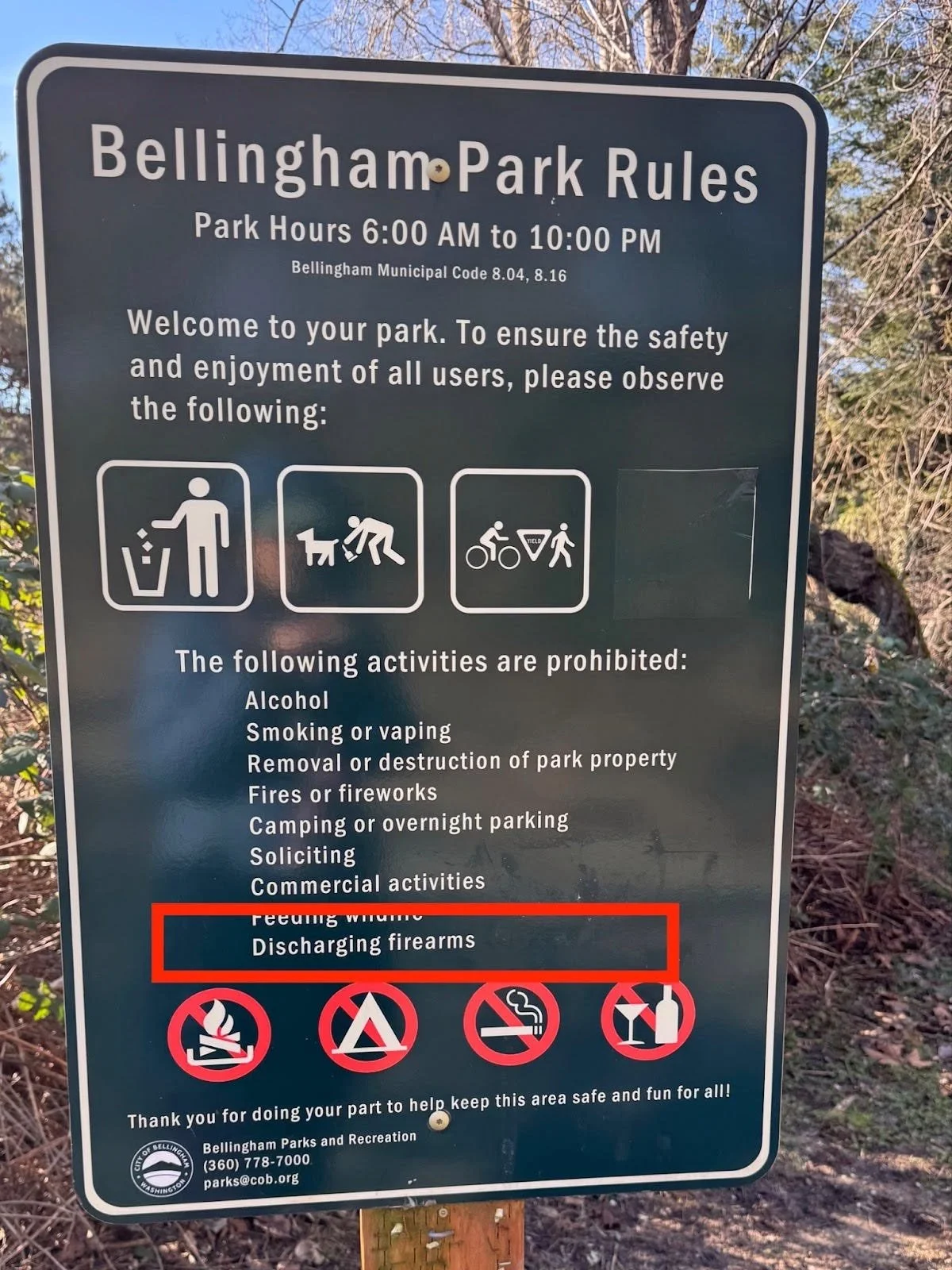
Park rules prohibit the discharge of firearms.
They do not prohibit their presence.
Within that distinction, this park, where Teddy and I walk nearly every day, is a place where infants are held close, babies sleep in strollers, toddlers puddle splash with glee, and children practice new modes of locomotion in freedom and trust. People toss balls, pick up poop, meet friends, and carry their own troubles and sorrows. Some walk at a fast clip; others as age demands. Souls and bodies come here wanting to be in a place that is still—mercifully—a little wild. Last year, to the obvious, curious wonder of those who stopped to look, Great Blue Herons built a rookery.
Following the incident, the man who drew the gun was charged. After his court appearance, the firearm was returned to its owner.
I think of the babies. I stop to see a new one. How old? Three weeks. Last Christmas Day, it was fun to see kiddos on the first bikes—tricycles wobbling, parents close. This is what peace of mind looks like in action. It is what allows learning, risk, and trust to unfold without calculation.
Why are guns allowed in the park? Because no city in Washington state has the right to prohibit guns in the park. That is a right controlled by the state. Years ago, a police officer quietly suggested to a man who was legally carrying a gun openly that the weapon frightened people. In response, the man sued the city. The court ruled in his favor, holding that Washington law allows open carry and that the officer had no legal authority to suggest the gun be put out of sight. The city paid a $15,000 settlement and retrained its officers and dispatchers accordingly.
The law was upheld.
Peace of mind was not.
We now live between two bookends mere days apart: a neighbor facing a gun in a park, and the killings of Renée Nicole Good and Alex Pretti. Federal agents discharged lethal force in circumstances that did not meet the standard legal justification for law-enforcement shootings. Former prosecutors and attorneys general have called these acts what they are—killings.
Temperament itself is morally neutral—each of us is born with a nervous system as distinct as a fingerprint. But it is the task of adults, and of society, to shepherd behavior so that individual volatility does not become collective danger.
International programs like Roots of Empathy show what matter-of-fact acceptance of difference looks like in practice. Public school children, seated in a circle on a green blanket, with their Tiny Teacher at the center, learn experientially—through touch, observation, and presence. No emotion or response is labeled right or wrong. Their teacher is a three-month-old infant who, over the next nine months, grows before their eyes under their parents’ care. I was a Roots of Empathy instructor in first- and third-grade classrooms. I saw attachment, attunement, and awe appear instantly at the first visit and deepen with each return. Independent research shows these effects last.
Peace of mind is not sameness. It is the capacity to stay steady while another’s needs, rhythms, or intensity differ from one’s own. Public safety includes psychological safety. Peace of mind is not a luxury; it is a civic condition.
Washington’s open and concealed carry laws are grounded in individual rights, not in collective nervous-system regulation. The law asks: Is the weapon legal? Is the carry permitted? It does not ask what visible lethal force does to children, elders, or the already vigilant—or what conditions allow people to remain attentive and relational in public space. Laws do not prevent eruptions of rage.
Historian Timothy Snyder reminds us that democracy does not begin with elections; it begins with care. Civic truth erodes when vulnerability—especially children’s vulnerability—is denied, minimized, or treated as incidental. We know this intuitively. When a baby is born, no one says, We’d better start building a university so there’s somewhere for this child to go in eighteen years. We expect certain things to already be in place: safety, steadiness, attention. Democracy depends on the same unspoken infrastructure.
In her January 27 Letters from an American, Heather Cox Richardson documents the current patterns of national emergencies in motion. They arrive locally—not as abstractions, but as fear that interrupts sleep, trust, and folding the laundry.
The civic and nervous-system consequences are sacking the country’s peace of mind.
Democracy is not only laws and institutions. It is a daily practice in adjacency—in showing up, in staying in motion together, in refusing to leave one another isolated. Like starlings in murmuration.

Photo source: Sjo, www.sjo.nlNo leader.
No command center.
Just attention—each bird responds to the seven nearest neighbors.
When predators approach, they do not scatter. They move together, shaping safety through relationship.
Care does not always scale upward. Often, it moves sideways. It begins with noticing who is nearby, what they carry, and how steadiness is shared.
Protection can be collective.
Direction can be shared.
Murmurations show what is always true: the sky is forever in motion. When unmoored, attention can turn to the sky.
Yes to life, in spite of everything.
Notes
City of Bellingham open-carry settlement (2016).
A federal court ruled in favor of a citizen openly carrying a firearm in a public park after a police officer suggested the weapon frightened others. The city paid a $15,000 settlement and retrained officers and dispatchers on Washington State open-carry law.
Use of force by law enforcement (United States)
Under U.S. constitutional law, the use of lethal force by law enforcement is governed by the Fourth Amendment’s “objective reasonableness” standard, as articulated by the Supreme Court. Deadly force is justified only when an officer has a reasonable belief that a suspect poses an immediate threat of serious physical harm to the officer or others, assessed from the perspective of a reasonable officer at the scene, not with hindsight. The standard does not permit lethal force solely to punish, deter, or control, nor in the absence of an imminent threat.
An international, evidence-based educational program founded by Mary Gordon. The program brings an infant and parent into classrooms over a school year, allowing children to learn emotional literacy, empathy, and self-regulation through direct observation and relationship. Longitudinal studies show lasting reductions in aggression and increases in prosocial behavior.
Heather Cox Richardson, Letters from an American, January 27, 2026.
Richardson documents the national patterns of federal violence, surveillance, and constitutional erosion, providing the historical and political context within which this NOTICING is situated.
Nationwide context and Washington State (video).
A public address reflecting on the current nationwide crisis and its particular resonance in Washington State, where this NOTICING is situated.
Viktor E. Frankl, Yes to Life: In Spite of Everything, Beacon Press, 2021
Viktor Emil Frankl was an Austrian neurologist, psychiatrist, philosopher, and Holocaust survivor Frankl’s posthumously assembled lectures affirm life not through optimism, but through responsibility and meaning under extreme conditions.
Starling murmurations are decentralized collective behaviors in which each bird responds to its nearest neighbors rather than to a leader. Safety and coherence emerge through attention and proximity, not command.
Adjacent Seven (Cup of Sugar).
A short reflection on proximity, attention, and shared regulation—how care and safety emerge through relation with those nearest rather than through command or hierarchy.